As a parent to twin boys and their older brother, I have learned that raising twins involves a constant balancing act. I want to treat them fairly, but fairness does not always mean treating them in exactly the same way.
As the founder of Teatime Tutoring, with 25 years of teaching experience, I see this issue from both sides. I am a parent trying to ensure that each child feels equally loved and valued, but also an educator who understands how important it is for children to develop confidence in themselves as individual learners.
Parents of twins are often asked whether their children are “the same” or “completely different”. In our case, the answer is both. My boys share a birthday, many experiences and, inevitably, a great deal of their daily lives. Yet their interests, personalities, strengths and approaches to learning can be remarkably different.
Whether twins should be placed in the same class is frequently debated, but this is only part of the picture. Even when taught separately, comparisons can follow them. The greater challenge is ensuring that each child is seen clearly as an individual.
The language of comparison
It is surprisingly easy for comparison to creep into family life:
“Your brother has already put his shoes on.”
“Look how quickly he finished his reading.”
I have caught myself making comments like these while trying to get everyone out of the door. Yet repeated comparisons can shape how children see themselves. One may feel less capable, while the other feels pressure to keep succeeding.
My twins both play tennis. One will practise diligently throughout the week, yet it is sometimes his brother who arrives at Saturday’s session, plays brilliantly and comes home with the trophy.
As their mum, I need to celebrate the winner while also recognising the other child’s persistence, commitment and improvement. There is room for both responses. The trophy is not the only achievement.
Tips for enhancing individuality
Our individuality factsheet is packed full of tips and advice for helping your twins, triplets or more develop their individuality. Join now as a Premium Member to access this and much more.
Avoiding labels
Labels can develop quickly when one twin grasps something more easily or struggles more visibly. One becomes “the academic one”, “the sporty one”, “the confident one” or “the one who needs help”.
These descriptions may be affectionate, but they become powerful when children begin repeating them about themselves.
We should also consider the messages passed on through our own experiences. Saying, “I was never any good at maths,” may be intended as reassurance, but a child may hear that struggling is inherited and permanent. Difficulty should feel like something that can be supported, practised and improved.
Twins notice more than we realise
My boys monitor each other constantly. If I ask what they ate for lunch, they often tell me what their brother had before remembering their own meal. They know who finished first, who answered a question in assembly and who was chosen for a particular role.
They notice differences even when adults avoid mentioning them. Our role is to help them understand that everyone has different strengths, challenges and rates of progress.
Real stories from your community
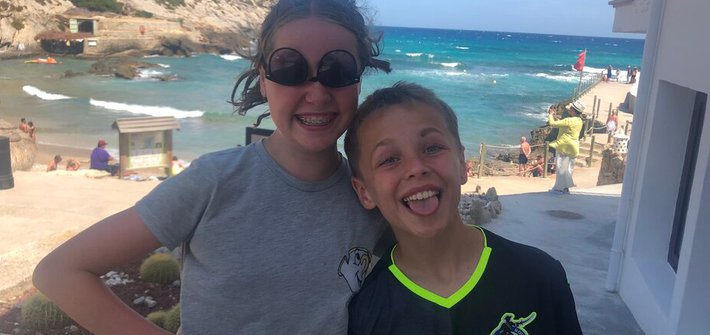
Teen twins: growing up together while finding your own identity
Twin bonds are like no other and there's always someone there by your side. Amy discusses her feelings on her relationship with her twin, Ben.
Managing homework differently
Homework can make differences particularly visible. Twins may bring home the same task but respond very differently. One may finish quickly while the other struggles or becomes reluctant.
In our house, one child may be ready to work immediately, while another needs a snack, a movement break and time to discuss the task. Insisting they complete homework in exactly the same way rarely helps.
Helpful strategies include seating children separately, breaking work into manageable chunks, praising concentration and perseverance, avoiding races and allowing movement breaks or different ways to record ideas.
If homework regularly causes distress, speak openly with the school. Sharing what happens at home can help teachers understand the whole child.
Keeping each child at the centre
At parents’ evening, each twin deserves a conversation centred on them. Alongside attainment, ask about confidence, friendships, independence and participation. Does each child speak up? Does one answer for the other? Are they developing separate friendships and interests?
Sometimes one twin may need different support. This does not mean they are less able. They may simply need more time, a quieter space or a different explanation.
One-to-one time is also valuable. In our family, one twin may go shopping with a parent while the other stays home with me for board games; both are doing what they love. These simple moments help each child feel recognised and treasured as an individual rather than always being half of a pair.
Connect with other parents
Our online communities are by you and for you. They're here to offer support and shared understanding for parents of twins, triplets or more.
Recognising when extra support may help
Extra support may help when homework regularly ends in tears, a child says, “I’m rubbish at reading,” or gaps in confidence are widening. It should never be about forcing one twin to catch up with the other. Instead, it should provide space to ask questions, revisit difficult areas and experience success away from comparison.
Separate journeys, side by side
Twins may travel through childhood side by side, but they remain on their own learning journeys. We cannot remove every comparison, but we can choose our language carefully, recognise individual progress and create opportunities for each child to succeed in their own right.
Supporting twins as learners is not about treating them identically. It is about responding to the child in front of us. One may need encouragement while another needs challenge. One may thrive in a busy group while another needs quiet reassurance. One may win the trophy, while the other deserves to have their persistence celebrated just as warmly.
As one twin mum said to me recently, “Fair does not have to mean the same.”
That is a message I return to often, both in my classroom and in my own home.
Published