Key takeaways
Twins and triplets can share a suitable cot while they are very young, small enough to fit safely and unable to roll or move around it
Each baby must be placed on their back with enough clear space so they cannot touch or obstruct each other’s breathing
Move the babies into separate sleep spaces as soon as any baby begins rolling or moving around the cot, or when they no longer have enough room to sleep safely
Twins or triplets can share a full-sized cot in the early weeks and months while they are still small enough. This is called co-bedding.
Many parents choose co-bedding because it saves space and can be comforting for their babies. Research suggests that sharing a cot may help twins regulate their body temperatures and sleep cycles and soothe each other. Sharing a cot does not necessarily mean that your babies will wake more often or always wake one another. Generally, multiples who are used to co-bedding do not disturb each other, although every baby is different and there will be exceptions.
Co-bedding is safest when your babies are in a full-sized cot. The shared space must have enough room for the babies to sleep safely without touching each other or obstructing each other’s breathing. This isn’t just about comfort. It also helps air to circulate around their faces and bodies and reduces the chance of overheating.
The cot should have a firm, flat mattress with a waterproof cover. Your babies should sleep in the same room as you for at least the first six months, during daytime naps and at night.
How should I position my babies?
Always place each baby on their back for every sleep.
Twins can be placed:
At opposite ends of the cot, with the tops of their heads facing each other and their feet at opposite ends
Side by side at the same end of the cot, with their feet at the foot of the cot and enough room between them that they cannot touch
Triplets can be placed:
Using both of the positions above, with two babies at one end and one at the other. Place every baby on their back in the feet-to-foot position, making sure there is enough room between them that they cannot touch
In a row on their backs, with their feet towards the long side of the cot, while they are still small enough to fit safely without touching. Baby sleep bags may be more practical in this position, as blankets may be difficult to tuck in securely around all three babies
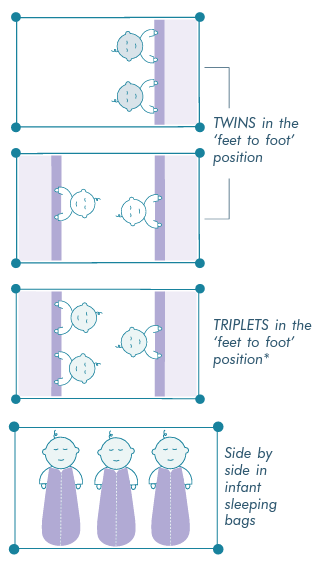
When using blankets, place each baby in the feet-to-foot position and firmly tuck the blankets in no higher than their shoulders. Alternatively, you can use baby sleep bags, but make sure they are well-fitting and they are suitable for each baby’s weight.
Do not place twins or triplets together in a small sleep space, such as a Moses basket, small cot or standard single-baby bedside crib. These spaces are too small to share. There is less room around each baby, reduced airflow around their faces and bodies and a greater risk of them overheating or their faces becoming covered.
Do not use rolled-up blankets, towels, pillows, cot dividers or other items to position, prop up or separate your babies.
As soon as any of your babies begins rolling or moving around the cot, move them into separate sleep spaces. This reduces the risk of them rolling into each other, obstructing each other’s breathing or overheating. You can place their cots close together so they can still see and sense each other.

Common questions about co-bedding
Can twins or triplets share a next-to-me or bedside crib?
A next-to-me crib is a type of bedside crib. Only use a bedside crib for more than one baby if the manufacturer clearly states that the particular model is designed and approved for that number of babies. Follow the manufacturer’s age, weight and developmental limits and do not assume that a crib is suitable simply because the babies appear to fit.
Each baby must have enough clear space around their face and body so that they cannot touch, roll into each other or obstruct each other’s breathing. The crib must also be securely attached to the adult bed, with no gaps where a baby could become trapped.
Follow all of our safe sleep guidance for twins and triplets, including placing each baby on their back, keeping the sleep space clear and using a firm, flat and waterproof mattress.
What if only one of my babies starts rolling?
As soon as any baby begins rolling or moving around the cot, all of the babies should move into their own separate sleep spaces. This prevents them from rolling into each other, obstructing each other’s breathing or overheating.
Can my babies share a cot for daytime naps?
Yes. The same co-bedding and safe sleep guidance applies during daytime naps and at night. Place every baby on their back in a clear, firm, flat and waterproof sleep space and keep them in the same room as you for at least the first six months.
My babies shared a cot in neonatal care. Should I position them in the same way at home?
Babies in neonatal care may be positioned differently or supported with specialist equipment because they are closely monitored. Once your babies come home, follow standard safe sleep guidance unless your neonatal team or another healthcare professional gives you specific advice for your babies.
Sleep on-demand course
Get practical sleep support, with expert guidance on sleep patterns, bedtime routines, sleep environments and managing common challenges.
Published