When one twin develops differently from the other, it can bring a unique set of challenges for the whole family. Here, one mum shares her experience of supporting her neurodivergent daughter Connie, while also making sure her twin sister Scarlett gets the support and space she needs.
We knew from when Connie was at pre-school that she was falling behind her peers. With her twin sister Scarlett right next to her, the differences between them were even more obvious.
I have worked at Twins Trust since the girls were one, so I knew first-hand that I shouldn't be comparing them with one another. But knowing that and actually doing it are two very different things. When you can see the educational gap between your children widening in front of you, it is incredibly difficult not to make comparisons.
Scarlett also naturally began to fall into the role of the ‘carer twin’.
When the girls started school, we decided to keep them together in the same class because, at that point, it was the best thing for them. Connie was receiving support through speech and language services and was given extra interventions at school.
Then Covid hit and the schools closed.
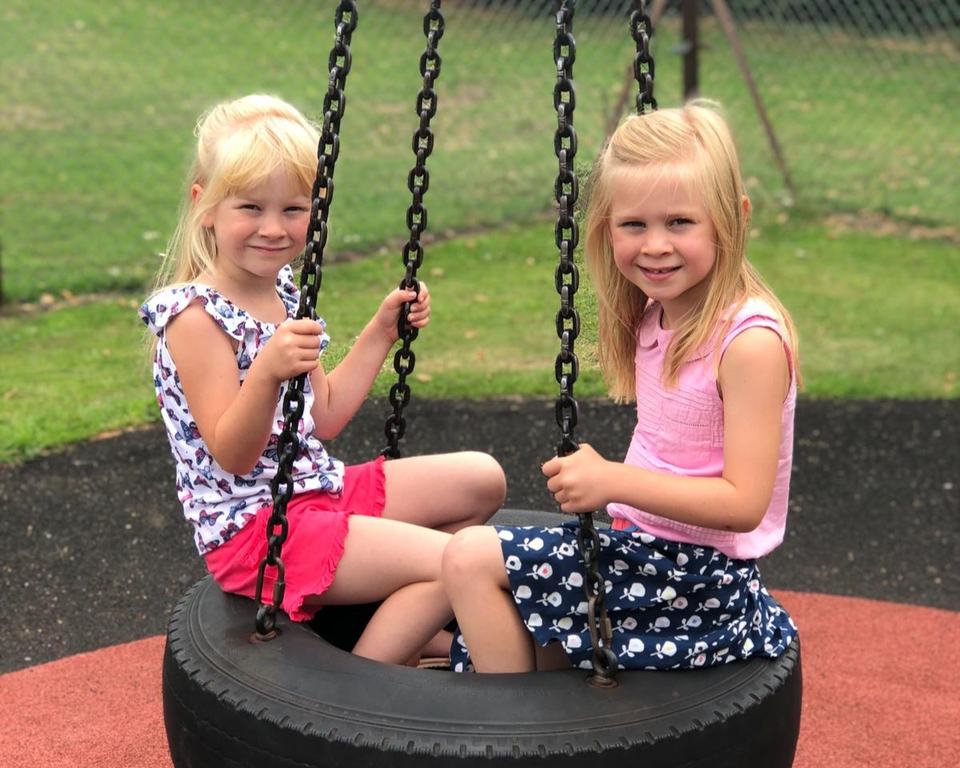
My husband and I both continued working throughout, so like many families we were suddenly trying to juggle work, home life and schoolwork. We were lucky to have a lovely summer and the girls spent a lot of time playing freely together.
But when it came to their schoolwork, I could see the differences in their reading, writing and maths more clearly than ever. They were being given the same work and seeing how much Connie struggled with something that Scarlett could manage made the gap feel magnified.
When Connie was in Year 2, she was diagnosed with dyslexia, like her older sister Daisy. This enabled us to begin the process of applying for an Education, Health and Care Plan (EHCP). During the assessments that followed, Connie was also diagnosed with autism spectrum disorder (ASD) and attention deficit hyperactivity disorder (ADHD).
At the same time, we realised we needed to think about the impact on Scarlett.
I applied for young carers support for her because we could see how much responsibility she felt for her sister. If Connie was ill and couldn't go to school, we often struggled to get Scarlett to go in without her. If Connie was sent home during the school day, Scarlett would often appear with her when we arrived to collect her, so we would end up taking both girls home.
But if Scarlett was ill, Connie was quite happy to go into school without her.
That difference really highlighted how much of a caring role Scarlett had taken on.
You belong here
Our community of families with twins and triplets is unique. We lean on each other, cheer for one another and together we're stronger. Join today as a Free Member.
Having children with additional needs inevitably affects family life too. I remember one day when Scarlett cried and told me she wished she was dyslexic so she could be like her sisters.
That really stayed with me.
So much of my time was taken up helping Connie and my eldest daughter Daisy with homework and everyday tasks they found difficult. As a parent, you already worry about whether you're giving your children enough time and attention, but I became very aware that Scarlett could be missing out because I was so often supporting her sisters.
I started deliberately making time just for her. Sometimes we'd go to the library, get a drink together or simply go for a walk. It didn't have to be anything big. It was about giving her some time where she had my attention and didn't have to be someone's sister or carer.
Being the parent of neurodivergent children can sometimes feel like having another job. I often feel like I am their mouthpiece, making sure the right plans are in place for their education and that they are getting the support they need and deserve. There is always paperwork, another meeting, another form or another conversation to have.
We don't use Connie's diagnoses as an excuse for her behaviour. She is parented in the same way as our other children, with the same boundaries, although we recognise that she may sometimes need different support to meet them.
Some days have been really difficult. There have been tears and plenty of moments when I've wondered whether I'm doing a good enough job.
But I wouldn't change Connie.
She is one of the kindest and most thoughtful girls you could meet and she is a brilliant friend. Since starting secondary school, she has made some lovely friendships of her own.
At primary school, I often felt that she was friends with Scarlett's friends rather than having her own friendship group and that she never quite found where she fitted. Since moving to secondary school, she has really come into her own. Seeing her make her own friends and grow in confidence has made us incredibly proud.
Perhaps some of my worries about Connie's future also come from my own family experience. My brother has ASD and lived with my parents for a long time. Growing up, I used to wonder whether he might eventually come and live with me.
Instead, he has gone on to have his own property and works hard for a living.
We have no idea what the future will look like for Connie either.
As her parent, I will probably always worry about what comes next and whether she will have the support she needs. But I am also learning that her path doesn't have to look like Scarlett's, Daisy's or anybody else's.
It just has to be Connie's.
We've got you
If you need to talk things through, we're here to help. Our trained helpline volunteers are here to listen and everyone you speak to is a parent of twins, triplets or more, so they get it.