Key takeaways
MCMA twins make up around 1% of all twin pregnancies and around 5% of monochorionic twin pregnancies.
MCMA triplets are extremely rare, occurring in around 1 in 100,000 pregnancies.
In both MCMA twins and triplets, the babies share one placenta and one amniotic sac.
Chorionicity (the number of placentas) and amnionicity (the number of amniotic sacs) should be diagnosed at the dating scan, between 11 and 14 weeks of pregnancy.
MCMA pregnancies are considered high risk because of the increased risk of complications.
MCMA pregnancies should be managed by a specialist team with experience in caring for this type of pregnancy, with frequent ultrasound monitoring.
What are MCMA twins and triplets?
Monochorionic monoamniotic (MCMA) twins share both a placenta and an amniotic sac. They are a rare type of twins, making up around 1% of all twin pregnancies and 5% of monochorionic twin pregnancies.
MCMA triplets are extremely rare, occurring in around 1 in 100,000 pregnancies. They are the rarest type of triplet pregnancy, with all three babies sharing one placenta and one amniotic sac.
MCMA pregnancies occur when a fertilised egg splits late in its development, resulting in the babies sharing a single placenta and amniotic sac.
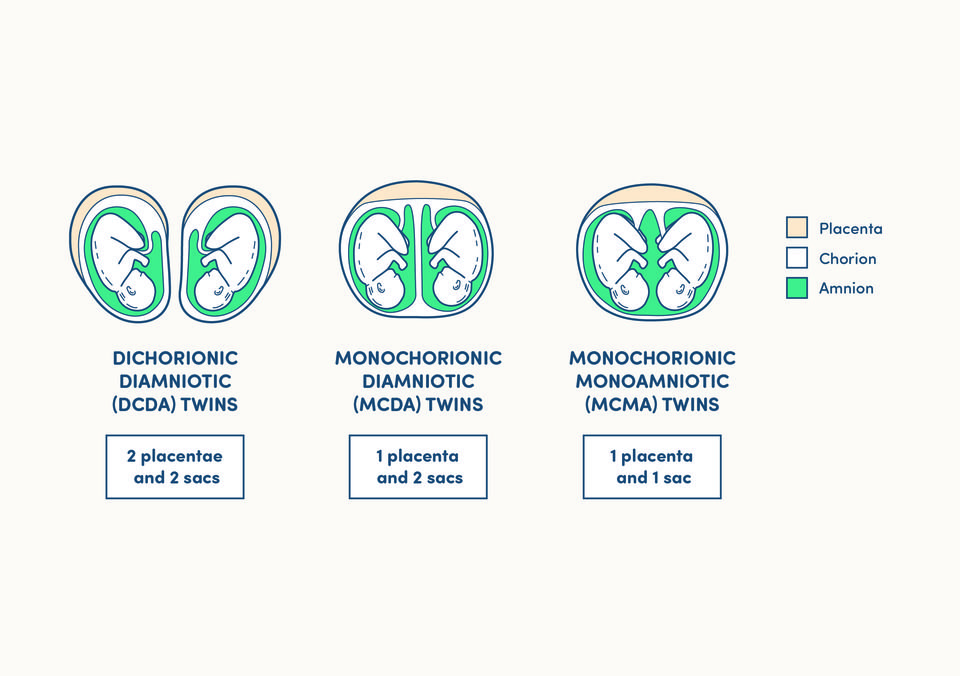
Diagnosing MCMA twins and triplets
The chorionicity (number of placentas) and amnionicity (number of amniotic sacs) of a multiple pregnancy should be diagnosed at the dating scan, between 11 and 14 weeks of pregnancy.
It is important that this diagnosis is made as early and accurately as possible. If your health professional is unsure whether your pregnancy is MCMA and there is still doubt about the diagnosis of chorionicity, you should be referred to a fetal medicine specialist without delay, as chorionicity is best determined before 14 weeks of gestation.
If you are diagnosed with MCMA twins or triplets, your specialist team will develop an individualised plan of care for your pregnancy and birth.
What are the risks of an MCMA pregnancy?
MCMA pregnancies are considered high risk because sharing a placenta and an amniotic sac can increase the risk of complications.
Around 20% of MCMA twin pregnancies will have complications, compared with around 10% of monochorionic diamniotic (MCDA) twin pregnancies, where the babies share a placenta but have separate amniotic sacs.
The most common complication in MCMA twins and triplets is Twin Reversed Arterial Perfusion sequence (TRAP sequence). Other potential complications include:
- Twin-to-Twin Transfusion Syndrome (TTTS)
- Twin Anaemia-Polycythaemia Sequence (TAPS)
- Selective Fetal Growth Restriction (sFGR or sIUGR)
These complications are generally less common in MCMA twins and triplets than in MCDA pregnancies.
Because the babies share the same amniotic sac, their umbilical cords can also become tangled. Sadly, this means there is a risk of sudden and unpredictable fetal death due to cord accidents.
MCMA triplet pregnancies also have a higher risk of preterm (premature) birth and fetal loss.
Know the care you should be receiving
Empower yourself by knowing what type of care you should be receiving at each stage of your pregnancy and the questions you should be asking by downloading our antenatal care checklist.
Monitoring an MCMA pregnancy
Because of these risks, MCMA twin and triplet pregnancies are referred to a specialist or tertiary hospital with expertise in caring for this type of pregnancy.
For MCMA twins, ultrasound scans are generally carried out every two weeks from 16 weeks onwards. MCMA triplet pregnancies are also scanned every two weeks from 16 weeks onwards, although scans may be more frequent if advised by your specialist team.
These scans help your healthcare team monitor the babies' health and look for signs of complications. They may include:
- measuring the babies’ growth
- checking the amount of amniotic fluid
- assessing the babies' overall anatomy and development
- assessing blood flow
- looking for signs that the babies may be at risk of preterm (premature) birth
- monitoring differences in the babies' sizes.
For MCMA triplets, the frequency of monitoring for TTTS should be increased in the second and third trimester to at least weekly if there are concerns about differences between the babies' amniotic fluid levels.
Your specialist team will advise you about the monitoring schedule that is appropriate for your individual pregnancy.
Connect with other parents
Our online communities are by you and for you. They're here to offer support and shared understanding for parents of twins, triplets or more.
If complications are identified
If a complication is identified during your pregnancy, your health professional will talk you through the available treatment options. These will depend on the type of complication and your individual circumstances.
You can find more information about the management of complications in our booklet, Complications in your pregnancy with twins, triplets and more [opens as PDF].
Planning the birth
Because MCMA twins have a higher risk of fetal loss, a planned caesarean birth between 32 and 34 weeks is advised.
MCMA triplets have a higher risk of both preterm (premature) birth and fetal loss, so a planned caesarean birth is also advised. The timing will be carefully considered by your fetal medicine consultant, taking into account how the pregnancy is progressing and the potential risks to the babies.
Because MCMA pregnancies involve babies sharing both a placenta and an amniotic sac, early caesarean birth is often recommended to help minimise the risk of complications.
You should be offered steroids [LINK - steroids article] before delivery to help mature the babies' lungs.
Your specialist team will discuss your individual birth plan with you and explain why a particular timing and method of birth is recommended for your pregnancy.
Real stories from your community
Good communications helped us through our hour of need
Twin Ruby was diagnosed with a heart defect during pregnancy and faced surgery just two weeks after she was born.

Getting support
Being told that you have an MCMA twin or triplet pregnancy can feel overwhelming, particularly because you may hear that your pregnancy is considered high risk. Having specialist monitoring and care can help your healthcare team identify and manage complications as early as possible.
If you have any concerns about your pregnancy, speak to your health professional, who is best placed to advise you about your individual circumstances.
We've got you
If you need to talk things through, we're here to help. Our trained helpline volunteers are here to listen and everyone you speak to is a parent of twins, triplets or more, so they get it.
Published